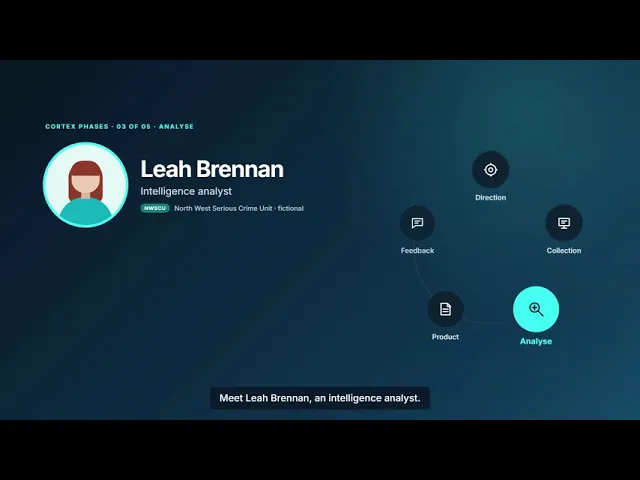
INTELLIGENCE LIFECYCLE · 03 / 05
Analysis
Make the judgement and its basis reviewable.
Analysis connects exact retained evidence to hypotheses, assumptions, judgements, uncertainty and independent challenge. Review applies to the content actually submitted, not to a report title or a permanently trusted author.
01 · Resolve the exact evidence
Search and inspect retained material within current access. Exact evidence selections preserve material, extraction and passage identities, so reprocessing does not silently change the basis of an assessment. Original-byte downloads and historical passages remain subject to authority checks.
Memory’s baseline retrieval is bounded, paged literal keyword search with documented filters. Optional semantic retrieval requires an approved, evidenced use case. An index retains access, correction and deletion obligations; its existence does not grant unrestricted corpus chat.
02 · Build a question-led evidence board
Create an analytical draft against the requirement. State the analytical question, context and limits. Resolve the passages actually used, then identify context, corroboration and contradiction as distinct evidence roles. Record credibility and assessment notes separately from source reliability.
Keep unsupported assertions and information gaps visible. Several citations may share a reporting origin and therefore do not necessarily provide independent corroboration. Preserve the evidence’s retained revision instead of replacing provenance with a mutable current title.
03 · Test alternatives and assumptions
Record competing hypotheses, assumptions, alternative explanations and discriminating checks. Evidence can support or contradict a proposition. Competing-hypotheses matrices, proportionate techniques, challenge and significant disagreement remain part of the analytical record.
Commissioned work supports falsifiable and time-bounded judgements, structured confidence factors and explanations of change. Indicators and observations can prompt deliberate reassessment. They do not silently replace the analyst’s judgement or erase the reasoning behind an earlier view.
04 · Separate probability from confidence
Probability is the assessed likelihood of a proposition or event. Analytical confidence describes the strength of the basis for that assessment. New submissions use the canonical PHIA terminology with separate confidence and substantive rationale.
Versioned schemes preserve historical meanings. A low-confidence, high-probability judgement is not contradictory merely because its dimensions differ. Source reliability, information credibility, handling and uncertainty are not interchangeable scores. Correct terminology does not establish objective truth.
05 · Review the exact revision independently
Save the draft and inspect the retained content. At least one hypothesis and judgement are required for peer-review submission, and unassessed or legacy probability choices must be resolved. Content under review is locked.
A currently eligible noncontributor reviews the exact revision and endorses it or requests changes. An amendment creates a new Draft and changed reasoning must be submitted again. A broad administrator role is not a substitute for reviewer independence. Endorsement is not dissemination approval.
06 · Record assurance and cited relationships
Assurance plans distinguish verification from fitness for the decision, retain findings against the eight PHIA standards and preserve separate commissioner sign-off. Approved contextual Defence lenses and futures methods extend the same retained workflow rather than replacing its evidence obligations.
Cited entities and relationships retain Draft, Proposed, Accepted or Rejected states. Corroborating and contradictory citations stay separate. Bounded graph traversal respects handling and visibility; an edge is a challengeable analytical record, not automatic proof of association.
07 · Hand reasoning into an authored product
The Product editor can build an editable draft from a selected retained analysis revision. It carries the question, judgements, probability, confidence, alternatives, assumptions, gaps and evidence roles, including contradictions. Authors confirm replacement of existing content.
Citation deduplication does not discard separate assessment text. Oversized analysis is rejected visibly rather than silently shortened. Linked analysis retains its access obligations for historical product revisions. A reviewed assessment does not itself close Direction or authorise distribution.
Documentation basis: CORTEX Master Project Reference, version 2.0, 28 September 2026. Capability descriptions follow its completed-scope basis; operational acceptance remains specific to the deployed release and environment.